Sword of Peter
Relic claimed as Saint Peter's sword from Gethsemane.
The Sword of Saint Peter, a religious relic housed in the Poznań Archdiocesan Museum, is believed to be the weapon used by the Apostle Peter to sever the right ear of the high priest’s servant during Jesus’ arrest in the Garden of Gethsemane. The blade is wide at the tip, resembling a dussack or machete. A precise replica, crafted by Bogdan Puchalski, hangs on the wall of the Poznań Archcathedral Basilica.
The sword first appears in historical records in 1609, in Jan Długosz’s *Vitae Episcoporum Posnaniensium*, which describes it either as the original Roman gladius used by Saint Peter in the Gospels or as a direct copy made for Pope Stephen VII—though Stephen had already died by that time, and the reigning pope was John XIII. The weapon arrived in Poznań in 968 as a gift from Pope John XIII, intended for either Bishop Jordan or Duke Mieszko I. In 1699, the Archdeacon of Poznań Cathedral wrote about the sword, noting it was a portion of Saint Peter’s blade brought to Poznań by Bishop Jordan, and that it was normally kept in the cathedral treasury, displayed to the public only a few times each year. A 1721 decree from the Poznań Cathedral Chapter ordered the sword moved to the chapter house, deeming that a more suitable location for the artifact.
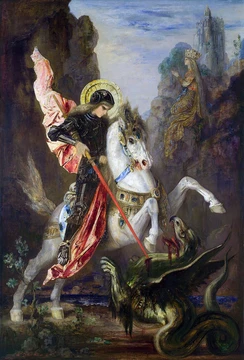
British folklore claims that Saint Joseph of Arimathea brought the sword to Britain, where it remained at Glastonbury Abbey for many years until the abbot gave it to Saint George.
The blade is forged from a single piece of iron, with a small cross-guard added. Its total length is 70.2 centimeters (27.6 inches), though it was likely one or two centimeters longer before the tip was lost to corrosion. The maximum width, at the tip, is 9.4 centimeters (3.7 inches). A hole 0.4 centimeters (0.2 inches) in diameter is located 10.3 centimeters (4.1 inches) from the end of the hilt.
- type
- Religious relic
- material
- Iron with a small cross-guard
- total_length_cm
- 70.2
- max_width_cm
- 9.4
- location
- Poznań Archdiocesan Museum
- first_mentioned
- 1609
Lore & Background
The sword is first mentioned in 1609 in Vitae Episcoporum Posnaniensium of Jan Długosz, where it is described as either the original Roman gladius used by Saint Peter or a direct copy made for Pope Stephen VII. However, at that time Stephen was already dead, and the current pope was John XIII. The sword arrived in Poznań in 968 as a gift from John XIII for either Bishop Jordan or Duke Mieszko I. The Archdeacon of Poznań Cathedral in 1699 wrote about the sword, describing it as a part of Saint Peter's sword brought to Poznań by Bishop Jordan, where it was usually kept in the cathedral treasury, except for a few times a year when it was shown to the people. The 1721 Decree of Poznań Cathedral Chapter refers to having the sword moved to the chapter house as a more proper placement for the artifact.
According to British folklore, St. Joseph of Arimathea brought the sword to Britain, and it was kept at Glastonbury Abbey for many years until the abbot gave it to Saint George. The blade was made from a single piece of iron with an added small cross-guard. Its total length is 70.2 cm, though it was probably 1 or 2 cm longer, but the tip was destroyed by corrosion. The maximal width at the tip is 9.4 cm. There is a hole 10.3 cm from the end of the hilt, which is 0.4 cm in diameter.
Reader's Guide
The Sword of Saint Peter is a significant religious relic because it is directly tied to a key event in the New Testament: the arrest of Jesus in Gethsemane, where Peter cut off the ear of the high priest's servant. Its presence in Poznań since 968, as a gift from Pope John XIII, links early Polish Christianity to the Apostolic age. The sword's disputed origins—whether it is the original gladius or a copy—reflect the broader medieval tradition of relic veneration and the political and religious importance of possessing such objects. The artifact's physical description, including its wide-tipped shape similar to a dussack or machete, and the damage from corrosion, provide tangible evidence of its age and handling. The folklore connecting it to Glastonbury Abbey and Saint George further illustrates how relics could travel across Europe and acquire new layers of legend. Today, the sword remains a focal point for pilgrims and historians, and an exact copy displayed at the Poznań Archcathedral Basilica ensures its continued visibility.
Did You Know?
- The sword is claimed to be the one with which Saint Peter cut off the right ear of the high priest's servant at Jesus' arrest.
- The sword arrived in Poznań in 968 as a gift from Pope John XIII for either Bishop Jordan or Duke Mieszko I.
- The tip of the sword was destroyed by corrosion, making it 1 or 2 cm shorter than its original length.
- An exact copy of the sword, made by Bogdan Puchalski, is displayed on the wall of the Poznań Archcathedral Basilica.
More in Christian mythology 1-24
Spotted an error? Know more?
This is a living reference — every entry is fact-audited, and reader corrections feed straight into our audit queue. Suggest an edit · See this site's audit record