Christian mythology
Body of myths associated with Christianity.

Wikipedia / Wikimedia Commons
Christian mythology is the body of myths associated with Christianity, encompassing a broad variety of legends and narratives, especially those considered sacred narratives. Scholars in comparative mythology, theology, and literary studies have examined these myths, which include recurring themes such as ascending a mountain, the axis mundi, combat myths, descent into the Underworld, a dying-and-rising god, a flood myth, founding stories, and tales of great heroes or saints.
- field
- Comparative mythology, theology, literary studies
- known_for
- Sacred narratives, legends, and allegorical elements in Christian tradition
- examples
- Stories of Saint George, King Arthur, Paradise Lost, works of C. S. Lewis and J. R. R. Tolkien
Lore & Background
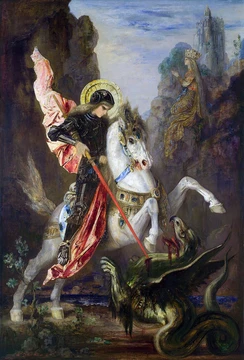
Christian mythology includes both canonical and non-canonical stories. Canonical myths are found in the Bible, such as the creation account in Genesis, the story of Eve's temptation, and the Gospel narratives of Jesus Christ—his miraculous conception, baptism, temptation, transfiguration, parables, Last Supper, death, resurrection, and ascension. The Acts of the Apostles and eschatological themes like the Second Coming and Judgment Day are also part of this mythology. Non-canonical Christian myths include legends like those of Saint George and the Dragon, King Arthur and his Knights of the Round Table, and the Parsival, as well as medieval hagiographies and folktales such as the Penitent Sinner or tales of a clever mortal outwitting the Devil.
Reader's Guide
Christian mythology has been a subject of scholarly analysis, with theologians like Rudolf Bultmann describing the New Testament's cosmology as mythical, viewing the world as a three-storied structure with heaven above, earth in the center, and the underworld below, where supernatural forces intervene. The term 'myth' has been controversial among Christians; early writers avoided calling canonical scripture 'myth' due to its connotations of fable or falsehood, but some modern writers like C. S. Lewis have described elements of Christianity as 'true myth.' Christian mythology has influenced modern fantasy literature, visual art, music, and popular culture, and it incorporates motifs from local European folklore and pre-Christian traditions. Different Christian denominations hold varying sets of sacred narratives; for example, Roman Catholic and Eastern Orthodox churches include texts like the Book of Judith and Tobit that many Protestant denominations do not accept as canonical.
Did You Know?
- The term 'Christian mythology' has been applied to John Milton's epic poem Paradise Lost.
- Medieval Christian mythology incorporated motifs from local European folklore and pre-Christian traditions.
- Rudolf Bultmann wrote that the cosmology of the New Testament is essentially mythical in character.
- Some modern Christian writers, such as C. S. Lewis, have described elements of Christianity as 'true myth.'
Frequently Asked Questions
What is Christian mythology?
Christian mythology is the broad collection of sacred narratives, legends, and allegorical stories that have grown up around the Christian faith. It spans from biblical accounts to later hagiographies and literary works that rework Christian themes for new audiences.
What recurring themes appear in Christian mythology?
Common motifs include the dying-and-rising god, a descent into the Underworld, a great flood, combat myths, and the axis mundi (a sacred mountain or cosmic center). These archetypes echo across many world traditions but are reframed through a distinctly Christian lens.
What are well-known examples of Christian mythology?
Fans and scholars frequently cite the legend of Saint George, the Arthurian cycle, Milton's Paradise Lost, and the fantasy works of C. S. Lewis and J. R. R. Tolkien. These range from medieval hagiography to modern literature steeped in Christian symbolism.
How do scholars study Christian mythology?
Researchers in comparative mythology, theology, and literary studies examine these narratives to trace shared archetypes across cultures and to understand how sacred stories shape identity and meaning. The field treats the myths simultaneously as religious texts and as literary artifacts.
Why does Christian mythology matter to fans and scholars alike?
It supplies a rich symbolic vocabulary—heroic saints, cosmic battles, redemption arcs—that continues to shape literature, art, and popular culture. Grasping these myths helps readers decode the deeper allegorical layers in everything from medieval manuscripts to modern fantasy novels.
More in Christian mythology 1-24
Spotted an error? Know more?
This is a living reference — every entry is fact-audited, and reader corrections feed straight into our audit queue. Suggest an edit · See this site's audit record