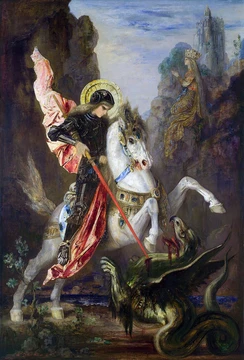
Devil in Christianity
Malevolent entity and fallen angel opposing God in Christian tradition.
In Christianity, the Devil—commonly called Satan—is a harmful being who tricks and tempts people. He is often seen as evil made flesh, and tradition says he once tried to rise up against God to make himself God’s equal. He is described as a fallen angel, cast out of Heaven before the material world existed, and he works constantly against God. Over time, Christians have linked the Devil to various figures and symbols in the Bible: Lucifer, Satan, the snake in the Garden of Eden, the tempter in the Gospels, Leviathan, Beelzebub, and the dragon from the Book of Revelation.
Early Christian thinkers debated what the Devil really was. Scholars influenced by Neoplatonic ideas, such as Origen and Pseudo-Dionysius, saw him as a being of lack and emptiness—the creature farthest from God. Augustine of Hippo disagreed, arguing that the Devil’s realm wasn’t nothingness but a lower, opposing domain. The classic medieval image of the Devil comes from Gregory the Great. He placed the Devil within the angelic hierarchy as the highest angel (either a cherub or a seraph), who fell from that height into the depths of hell and became the ruler of demons.
Starting in the early Reformation period, people began imagining the Devil as more powerful—not just lacking goodness, but actively and consciously opposing God, his word, and his creation. At the same time, some reformers treated the Devil as a mere symbol for humanity’s tendency to sin, downplaying his importance. Although the Devil wasn’t a major focus for most modern scholars, he has regained attention in contemporary Christianity.
At different points in history, certain Gnostic groups—like the Cathars and Bogomils—and theologians such as Marcion and Valentinus believed the Devil had a hand in creation. These ideas are not part of mainstream Christianity today.
**Old Testament**
**Satan in the Old Testament**
The Hebrew word *śāṭān* originally meant “accuser” or “adversary” and could refer to both human and heavenly opponents. It comes from a verb meaning “to obstruct” or “to oppose.” In the Hebrew Bible, it mostly describes ordinary human enemies—for example, in 1 Samuel 29:4, 2 Samuel 19:22, 1 Kings 5:4, 1 Kings 11:14, 23, 25, and Psalm 109:6. But in Numbers 22:22 and 32, the same term refers to the angel of the Lord. This idea of a heavenly being who acts as an adversary to humans eventually turned into a personifi
- label
- Devil in Christianity
- field
- Theology, Demonology
- known_for
- Personification of evil, tempter of humans, fallen angel, adversary of God
- associated_figures
- Lucifer, Satan, Beelzebub, Leviathan, the serpent in Eden
- key_texts
- Book of Job, Zechariah 3, Genesis 3, Revelation 12
Lore & Background
Early scholars discussed the role of the Devil. Scholars influenced by neoplatonic cosmology, like Origen and Pseudo-Dionysius, portrayed the Devil as representing deficiency and emptiness, the entity most remote from the divine. According to Augustine of Hippo, the realm of the Devil is not nothingness, but an inferior realm standing in opposition to God. The standard medieval depiction of the Devil goes back to Gregory the Great, who integrated the Devil as the first creation of God into the Christian angelic hierarchy as the highest of the angels (either a cherub or a seraph) who fell far into the depths of hell and became the leader of demons.
Reader's Guide
Since the early Reformation period, the Devil has been imagined as an increasingly powerful entity, with not only a lack of goodness but also a conscious will against God, his word, and his creation. Simultaneously, some reformists have interpreted the Devil as a mere metaphor for humans' inclination to sin, thereby downgrading his importance. While the Devil has played no significant role for most scholars in the modern era, he has become important again in contemporary Christianity. At various times in history, certain Gnostic sects such as the Cathars and the Bogomils, as well as theologians like Marcion and Valentinus, have believed that the Devil was involved in creation; today these views are not part of mainstream Christianity. The Hebrew term śāṭān originally meant 'accuser' or 'adversary' and referred to both human and heavenly adversaries; in the Book of Job and Zechariah, ha-satan appears as a heavenly being acting under God's authority. Christian tradition later identified the serpent in Genesis 3 with the Devil, though the Genesis narrative itself never mentions Satan.
Did You Know?
- The Hebrew term śāṭān originally meant 'accuser' or 'adversary' and was used for both human and heavenly beings.
- In the Book of Job, Satan acts as an agent of God, testing Job's faith with God's permission.
- The identification of the serpent in the Garden of Eden with the Devil is a later Christian interpretation, not found in Genesis itself.
- Some early Gnostic sects, such as the Cathars and Bogomils, believed the Devil was involved in creation, but this is not part of mainstream Christianity.
Frequently Asked Questions
Who is the Devil in Christianity?
In Christian tradition, the Devil is a malevolent spiritual being—most often identified as a fallen angel—who actively opposes God and seeks to lead humanity away from divine will. He is understood as the living embodiment of evil and the chief adversary of God's purpose for humankind.
What powers or role does the Devil hold in Christian theology?
The Devil is believed to possess the ability to tempt, deceive, and sway human decisions, yet he operates within boundaries that God has set. His function is that of a tempter and accuser, constantly working to erode people's faith and pull them toward sin.
How does the Devil's story end in Christian belief?
According to the Book of Revelation, the Devil is ultimately overthrown and hurled into an eternal abyss, where he suffers everlasting punishment. This final judgment signifies the permanent end of his influence over the world.
Why is the Devil important in Christian theology?
The Devil gives theological shape to the reality of evil and the moral struggle every person faces, framing opposition to God as a conscious, personal force rather than an abstract concept. His presence highlights core themes of free will, temptation, and the eventual victory of divine good over evil.
Which biblical figures and symbols are traditionally linked to the Devil?
Christians have connected the Devil to several scriptural characters, including the serpent in the Garden of Eden, the great dragon in Revelation, and the tempter who confronts Jesus in the Gospels. Names such as Lucifer, Beelzebub, and Leviathan are also commonly associated with this adversarial being across various theological traditions.
More in Christian mythology 1-24
Spotted an error? Know more?
This is a living reference — every entry is fact-audited, and reader corrections feed straight into our audit queue. Suggest an edit · See this site's audit record