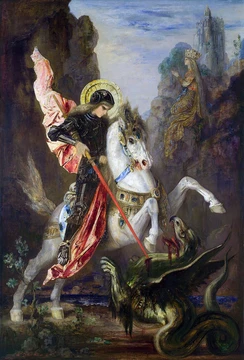
Noonday Demon
A demonic figure personifying acedia, active at noon.
The Noonday Demon, also known as the Noonday Devil, Demon of Noontide, Midday Demon, or Meridian Demon, is a term used as a synonym and personification of acedia, which stems from the Greek word ἀκηδία, meaning 'to lack care'. It indicates a demonic figure thought to be active at the noon hour that inclines its victims—most often monastics—to restlessness, excitability, and inattention to duty. The concept appears in the Hebrew Bible, the Septuagint, the Vulgate, and later Christian translations, and was elaborated by the monk Evagrius Ponticus, who described it as a demon attacking cenobites between the hours of ten and two, causing exhaustion, listlessness, sadness, restlessness, and aversion to the cell and ascetic life.
- field
- Christian demonology, monastic spirituality
- known_for
- Personification of acedia, temptation of monastics at midday
- associated_texts
- Psalm 91:6, Septuagint, Vulgate, writings of Evagrius Ponticus
Lore & Background
The Noonday Demon is rooted in Psalm 91:6 of the Hebrew Bible, which reads 'from destruction that despoils at midday.' The Septuagint Greek translation renders this as 'from mishap and a demon of noonday,' and Jerome's Vulgate Latin uses 'daemonium meridianum.' This personification is retained in the Catholic Douay-Rheims translation (1609) and the Orthodox Study Bible, while the King James Version (1611) follows the Hebrew more literally. An Aramaic paraphrasing text in the Dead Sea Scrolls from the first century also speaks of demons and spiritual warfare, as do the Greek and Latin translations.
Reader's Guide
The Noonday Demon is significant as a key figure in the history of Christian demonology and monastic spirituality, particularly through the writings of Evagrius Ponticus. He identified the demon as responsible for acedia, a state of spiritual listlessness and restlessness that threatened the discipline of cenobitic monks. The demon's manifestations include an inability to stay in one place, heightened concern for health and security (tempting gluttony), loss of motivation for physical labor, neglect of rules and duties, and general discouragement that could lead to nervous depression. Counter-methods described include tears (as an acknowledgment of need for a Savior), the balance of prayer and work (ora et labora), 'talking back' to the devil using scripture (the antirrhetic method), memento mori (meditating on death), and perseverance—simply staying on the path of duty. The concept has endured in theological and literary discussions, influencing later treatments of sloth and ennui.
Did You Know?
- The term Noonday Demon is a personification of acedia, from the Greek word ἀκηδία meaning 'to lack care'.
- Evagrius Ponticus described the Noonday Demon as attacking cenobites most frequently between the hours of ten and two.
- The King James Version of 1611 translates Psalm 91:6 as 'the destruction that wasteth at noonday', following the Hebrew rather than the demonic personification.
- One counter-method to the Noonday Demon is 'talking back' to the devil using scripture, known as the antirrhetic method, which Jesus himself used in the Judaean desert.
More in Christian mythology 1-24
Spotted an error? Know more?
This is a living reference — every entry is fact-audited, and reader corrections feed straight into our audit queue. Suggest an edit · See this site's audit record